Mnemonic State Decoding
Mnemonic brain states are whole-brain activity patterns that are recruited in support of memory encoding — the formation of new memories — and memory retrieval — the accessing of stored, already formed memories.
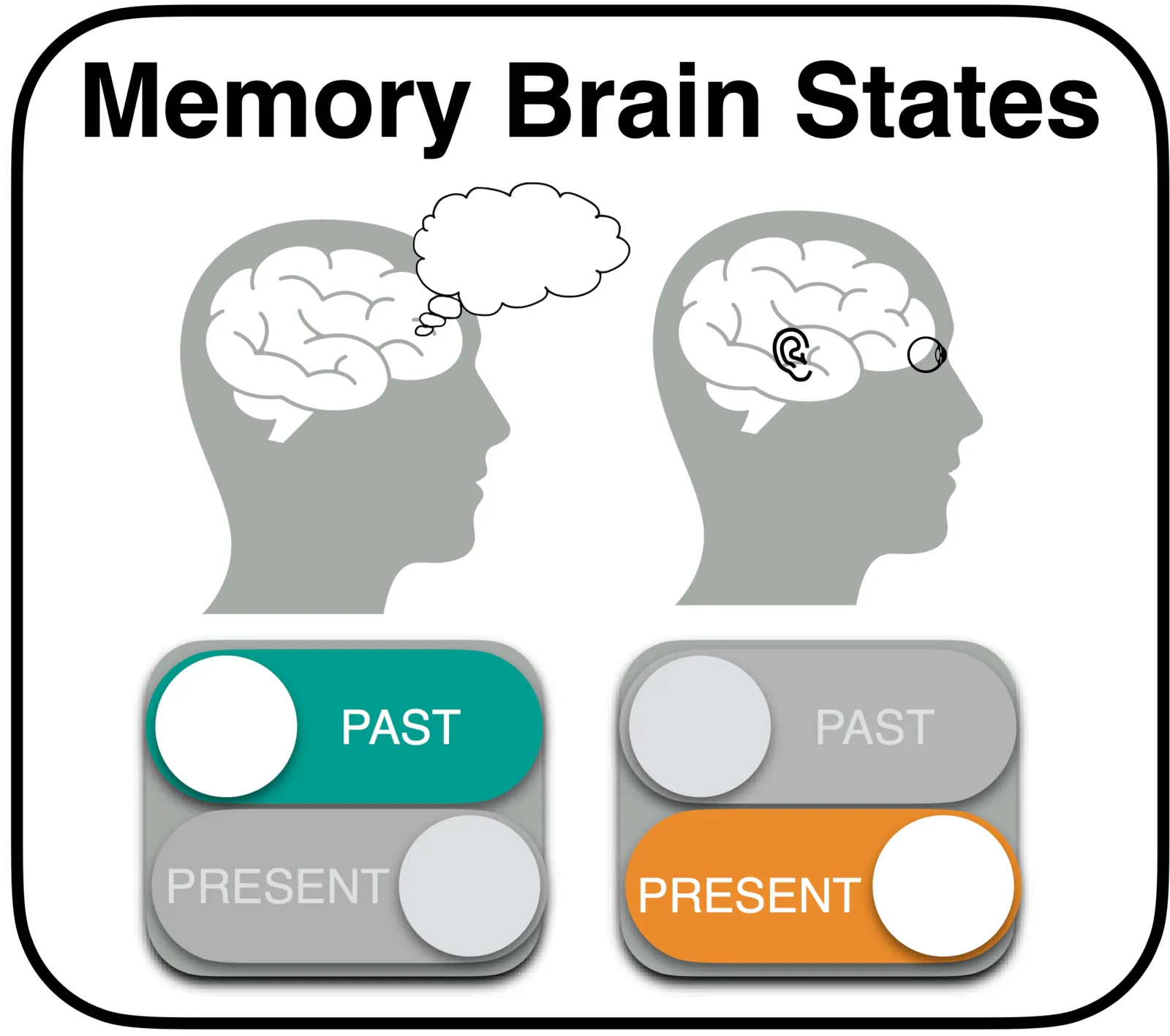
Our current understanding of mnemonic brain states
Each figure+blurb below highlights a key finding on mnemonic brain states.
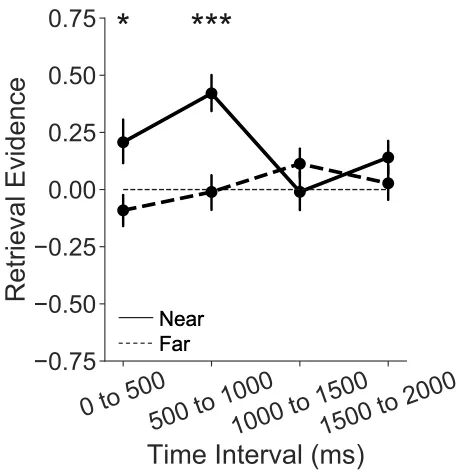
Temporal context influences retrieval state engagement
The retrieval state is recruited when two categorically related stimuli (e.g. a park bench vs. a wooden bench) are presented near together (solid line) in time compared to when presented far apart (dashed line) in time.
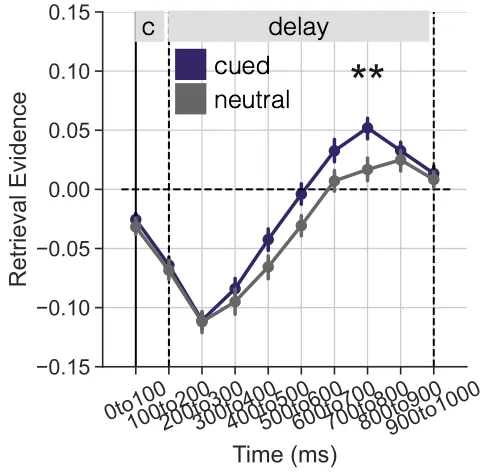
Selective spatial attention recruits the retrieval state
The retrieval state is recruited during a delay interval when participants maintain spatial attention to a cued (purple) location (left or right) relative to neutral or uncued (grey) trials.
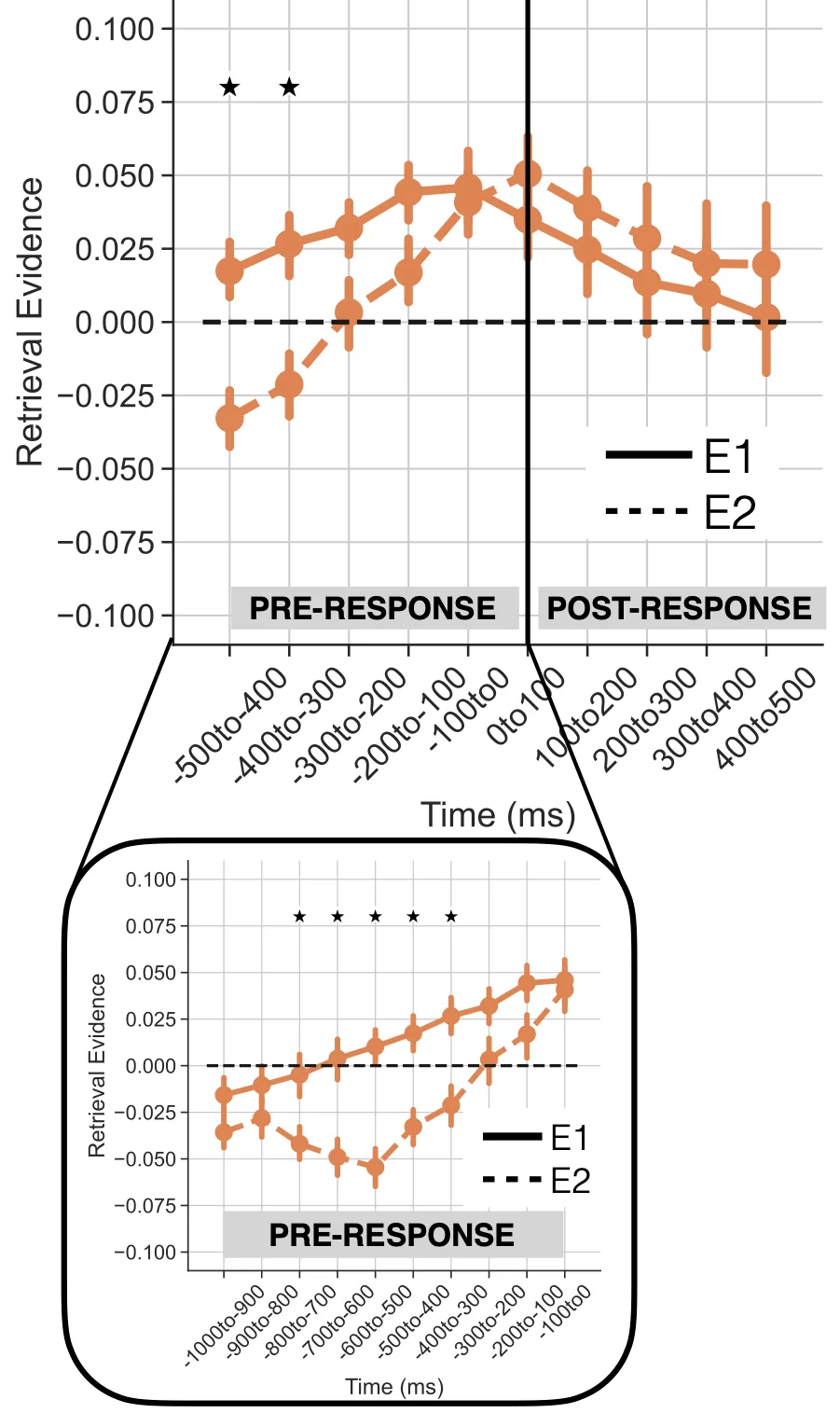
Temporal context influences retrieval state engagement
When participants attempt to recognize old items (E1, solid line), there is significantly more retrieval state recruitment during correct rejections (identifying new items as “new” or unstudied) compared to when participants detect new items (E2, dashed line).
Incongruity between consecutive trials recruits the retrieval state
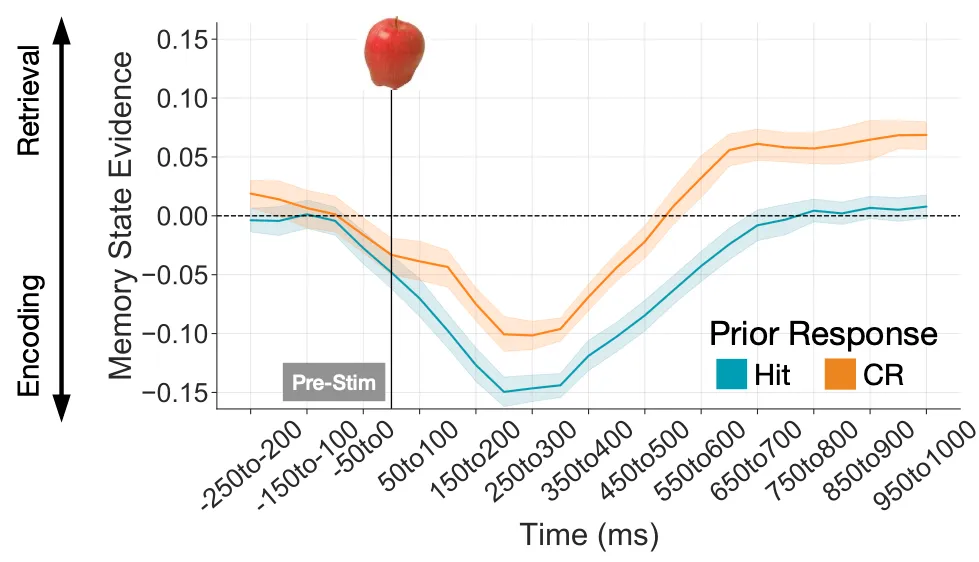
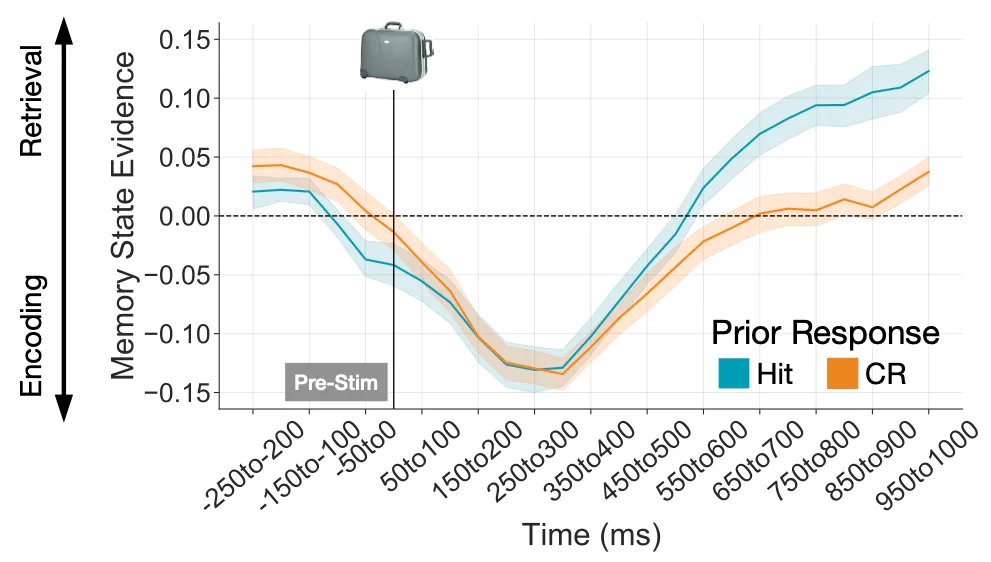
Whether participants correctly recognize a study item as old (red apple, left) or correctly reject an unstudied item as new (suitcase, right), the retrieval state is more strongly engaged when the current trial is incongruent with the preceding trial. There is more retrieval state evidence for hits preceded by correct rejections (left, orange line) and for correct rejections preceded by hits (right, teal line) than for either hits preceded by hits (left, teal line) or correct rejections preceded by correct rejections (right, orange line).
Mnemonic brain states are diminished in healthy aging
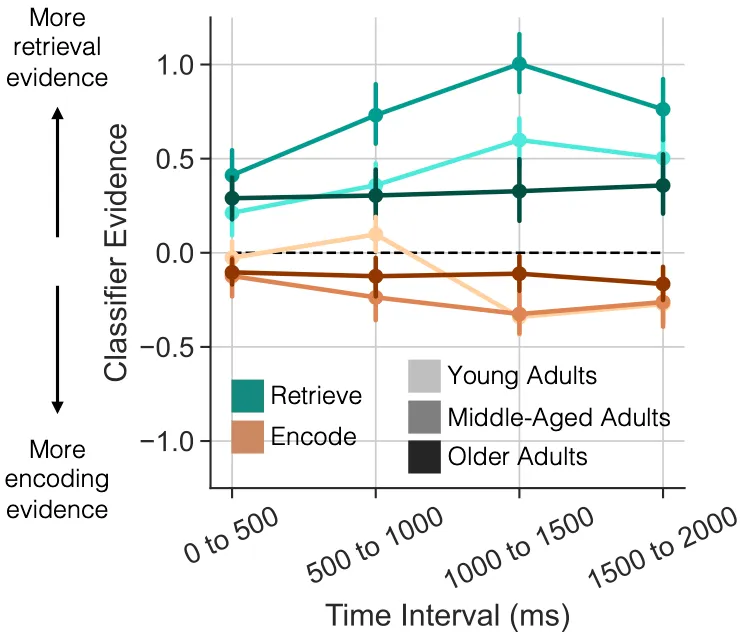
Healthy older adults (60-85; dark lines) show decreased engagement of both the encoding (orange) and retrieval (teal) state relative to young (light lines; 18-35) and middle aged (intermediate lines; 36-59) adults.
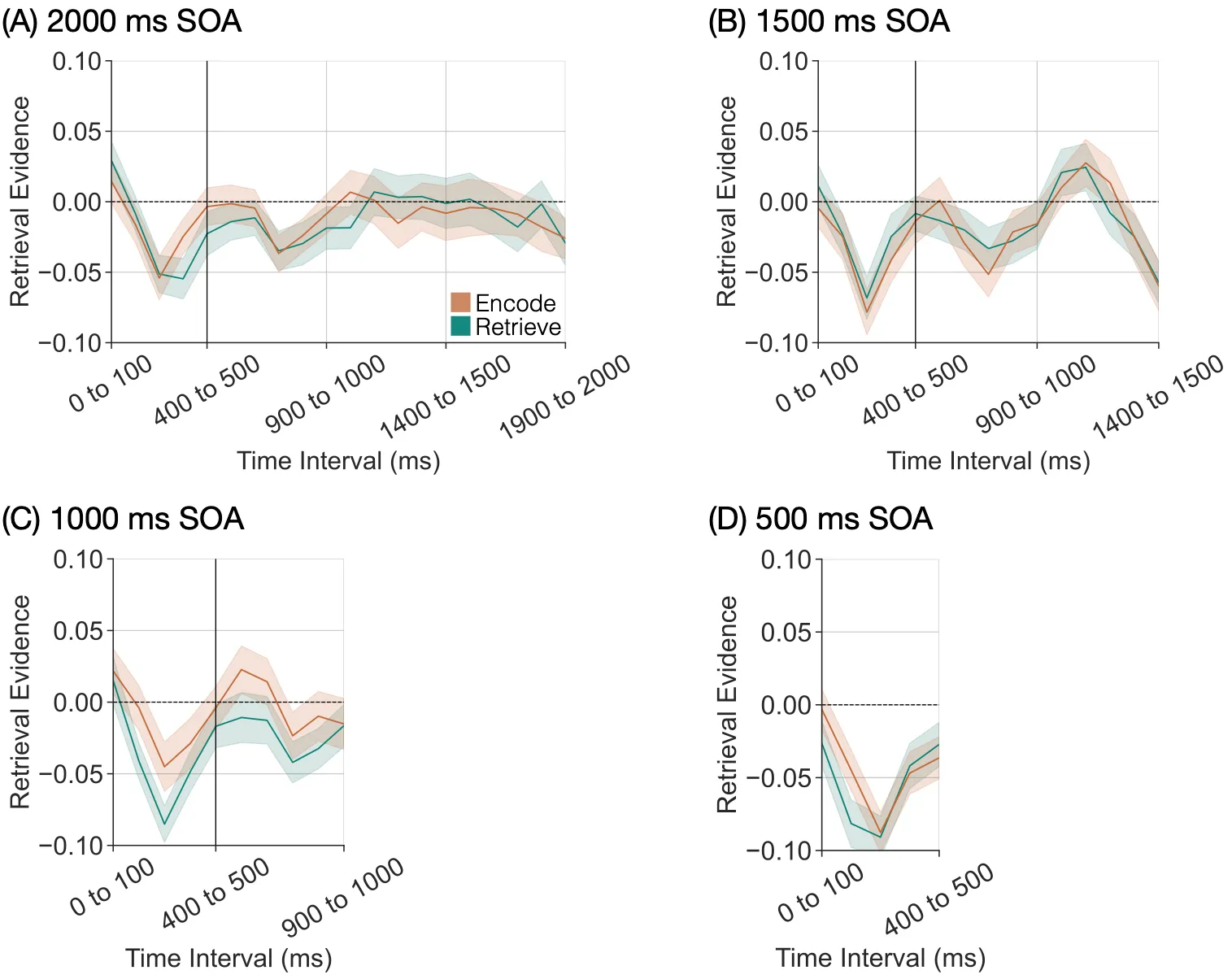
The retrieval state is reactionary
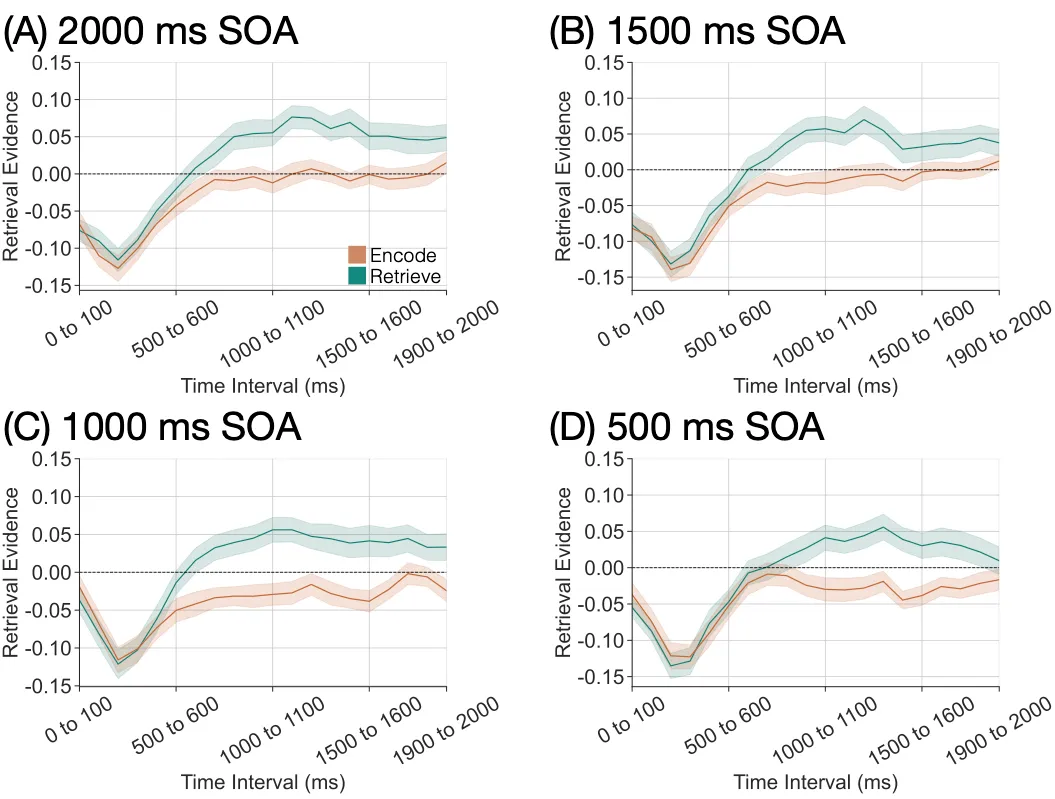
Mnemonic state dissociations are absent during the cue interval (left, vertical line indicates cue offset). Encode (orange) and retrieve (teal) trials are only dissociable during the stimulus interval (right).
Decode mnemonic brain states in your own data!
Our mnemonic state decoder is publicly available and can be applied to any EEG dataset.
Access the mnemonic state classifier
Common mnemonic brain state decoding questions
What is the mnemonic state task?
The mnemonic state task is a variation on the traditional AB/AC (or AB/AD) paradigm. Participants view two lists of images of categorically-related common objects. For example, if a participant sees a bench in the first list, they will see a different bench in the second list. In essence the first bench constitutes the “B” item, the second bench constitutes the “C” item, and their shared category (bench) constitutes the “A” cue. The critical manipulation is that during the second list, we tell participants whether they should encode the currently presented bench or retrieve the previously presented bench. In this way, we explicitly bias participants to encode or retrieve.
How matched are "NEW" encode and "OLD" retrieve trials in the mnemonic state task?
Encode/retrieve trials are as closely matched as possible:
- Perceptual input is the same: every trial includes a “new” (not previously presented) object image that is categorically related to an object image previously presented in List 1
- Motor output is the same: participants do not make any responses during either encode or retrieve trials
- Judgments/decisions are the same: participants do not make any decisions about the object images
Without behavioral responses, how do you know if people successfully retrieve on "OLD" retrieve trials in the mnemonic state task?
The short answer is: we don’t. However, the retrieval state (or mode, Tulving 1983) is thought to be a necessary precursor of, but distinct from, successful retrieval. In other words, you engage the retrieval state in the attempt to retrieve regardless of whether you are ultimately successful in that attempt. That we find retrieval state modulations in the absence of episodic memory demands (Long 2023) is consistent with this framing of the retrieval state.
How can you be sure that participants do the task at all?
We test memory for all items at the end of the session. Better memory for List 2 items paired with the “NEW”/encode instruction relative to List 2 items paired with the “OLD”/retrieve instruction indicates that participants differentially processed those items in response to the instruction cues.
Why do you only use a subset of participants to train the classifier?
Although we have collected data from over 100 participants in the mnemonic state task, not all participants show robust mnemonic state decoding. There are multiple potential reasons for why within-participant classification may fail — some more interesting than others. Poor data quality, either in terms of participant behavior or in terms of noisy brain signals, will negatively impact classifier performance. We typically exclude participants whose data are of poor quality, so this is less likely to account for low classifier performance. Instead, we think that some participants might not engage mnemonic brain states in exactly the same way (i.e. using the exact same substrates) across every trial and even throughout the trial. Thus, our classifier, which is trained on all trials over the full stimulus interval (2000 ms) may not be able to distinguish encoding and retrieval in such participants. However, this does not preclude the possibility that shared substrates underlie mnemonic states; rather, variable recruitment of those substrates may relate to important individual differences.
How can you say that encoding and retrieval tradeoff given evidence for processes like reconsolidation?
The premise that encoding and retrieval tradeoff stems from rodent and theoretical work conducted by Michael Hasselmo and colleagues showing that differential — and specifically opposing — hippocampal circuitry support encoding and retrieval. Thus, at the level of the hippocampus, the two states cannot be engaged in simultaneously. The ability to switch between these two states is a critical open question that may account for a host of behavioral effects across cognition and the lifespan — we are currently pursuing projects related to this question.
There is a lot of evidence that patterns of activity during study are reinstated or reactivated at test. How does that fit with an encoding-retrieval tradeoff narrative?
The critical distinction here is that of representations vs. processes. We expect the processes of encoding and retrieval to differ, but not necessarily the representations. Given a long history of evidence to suggest that the regions which support the perception of a stimulus also support the knowledge for and memory of that stimulus (e.g. Allport 1995), the representations of a stimulus may be preserved between encoding and retrieval. Such an account makes sense from a ‘storage’ perspective of the brain – why would we have two completely distinct systems to represent an external percept (encoding) and an internal image (retrieval)? However, it is important to note that there is recent evidence to suggest that representations may be transformed between the two states (e.g. Favila et al. 2020; Long & Kuhl 2021; Steel et al. 2024).
What regions/frequencies/features drive the classifier?
We believe that assigning specific features to mnemonic states is antithetical to the conceptual idea of a ‘brain state.’ First there is the practical consideration that as we use regularized logistic regression, the classifier is designed to create sparse weights. As a consequence of this design, if there are two highly correlated features which respond similarly for one condition (e.g. retrieval), only one of the two features should end up being leveraged by the classifier. Thus, feature weights do not tell us how the brain solves a problem/carries out a function, but instead tell us what information the classifier is using, which is not something in which we are especially interested. Second, although univariate approaches have been immensely valuable in laying the foundation for much of our current understanding of how the brain gives rise to the mind, we seek to advance understanding by moving beyond these approaches to investigate whole-brain and network-level effects. Although technically possible, a direct contrast of signals between encode and retrieve trials would leave us with hundreds to thousands of univariate comparisons to reconcile and interpret, significantly detracting from the utility of multivariate methods. Ultimately, we do not expect brain states to be supported by a single region and/or frequency.